A small coding mistake can create extra work for a medical practice. A claim may need correction, a biller may need to contact the payer, or staff may have to review the patient’s record again.
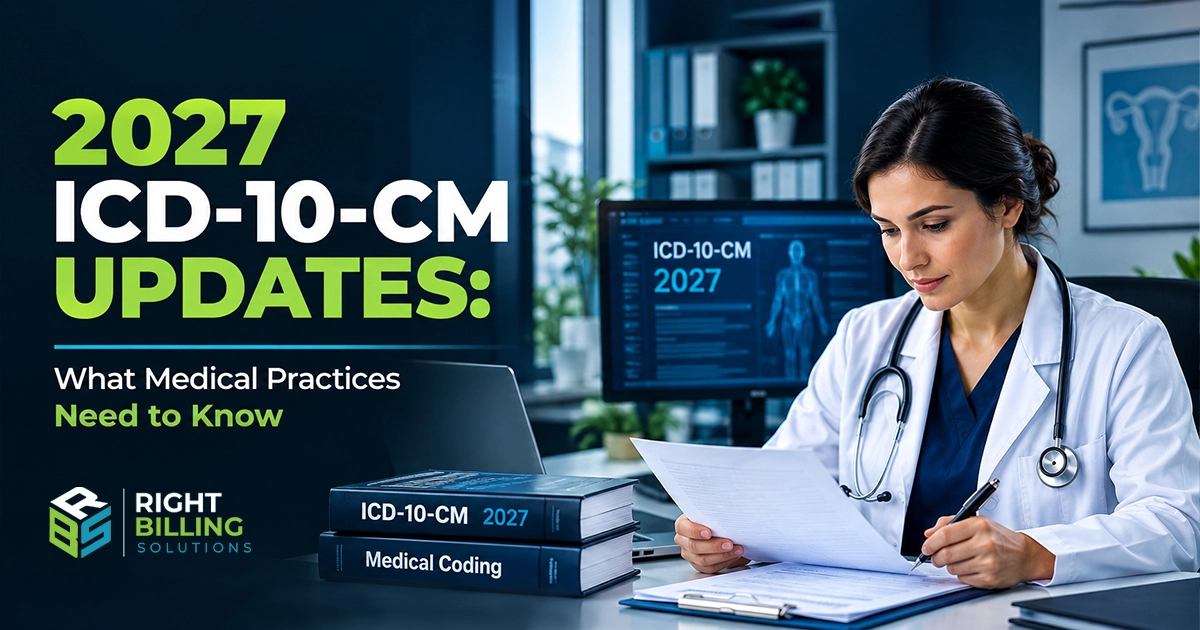
The 2027 ICD-10-CM updates make this an important issue for medical practices. The codes used to report diagnoses can change every year, and staff need to know which code set applies to each date of service.
The FY 2027 ICD-10-CM code set took effect on October 1, 2026. The new fiscal year runs through September 30, 2027. Practices should check the official files and update any tools that still use an older code set.
This guide to the 2027 ICD-10-CM updates explains where to find the new files, what to check, and how to reduce avoidable coding errors.
When Did the 2027 ICD-10-CM Updates Take Effect?
The FY 2027 ICD-10-CM code set became effective on October 1, 2026. It applies to the relevant reporting period through September 30, 2027.
You can check the release details in the CDC’s official ICD-10-CM files.
The effective date matters when your team reviews a claim. The 2027 ICD-10-CM updates apply to dates of service on or after October 1, 2026. Earlier dates of service still use the older code set. An old code list saved on a computer may not show the latest changes.
Start by checking the release used by your practice. Then compare it with the official FY 2027 files.
Where Can You Find the Official 2027 ICD-10-CM Codes?
Use official government sources when checking a diagnosis code or its instructions. These resources help your team review the 2027 ICD-10-CM updates and avoid mistakes caused by outdated lists or incomplete descriptions.
- CMS ICD-10 resources: Find official coding files and related guidance.
- CDC ICD-10-CM files: Review the annual code releases and supporting files.
- FY 2027 ICD-10-CM Official Coding Guidelines: Read the official rules for diagnosis coding and reporting.
Each resource serves a different purpose. The Alphabetic Index helps you look up a diagnosis. The Tabular List provides the code details and related instructions. The addenda help you identify changes between releases.
Do not choose a code based only on a search result or a short description. Check the full entry and its instructions before using it on a claim.
What Should Practices Check in the 2027 ICD-10-CM Updates?
Not every change in the 2027 ICD-10-CM updates will affect every practice. Focus on the diagnoses your providers report and the services your team bills most often.
1. New diagnosis codes
New codes may allow a condition to be reported in greater detail. Your team should check whether any additions apply to the diagnoses commonly seen in your practice.
Start with the official code files. Then check your EHR, billing software, diagnosis lists, and coding tools.
For example, if a provider documents a condition that matches a newly available code, the coding team should confirm that the record supports its use. A new code should not be selected just because its description seems close to the diagnosis.
2. Revised or deleted codes
Some existing codes may change or become invalid for the new reporting period. This can affect saved diagnosis lists and templates.
Check the official addenda for relevant revisions and deletions. Update the references your team uses every day.
Pay close attention to saved favorites in your EHR. They can speed up coding, but they can also lead to mistakes if they contain outdated entries.
3. Changes to coding instructions
A code’s description does not tell the whole story. Its instructions may affect when and how it can be reported.
Review the relevant Tabular List notes and official guidelines. Check whether the diagnosis requires more detail or whether another coding instruction applies.
If the medical record does not contain the information needed to support a code, do not guess. Follow your practice’s process for asking the provider to clarify the documentation.
4. Changes that affect your specialty
A code update may matter greatly to one specialty and have little effect on another.
For example, a practice that often reports a particular group of diagnoses should check those codes first. A practice that rarely uses them may need a smaller review.
Make a list of your most common diagnoses. Compare that list with the FY 2027 files, then identify the changes that affect your team.
This approach saves time and helps staff focus on the codes they actually use.
How the 2027 ICD-10-CM Updates Affect Medical Billing
Diagnosis codes help explain why a patient received care. They also form part of the information sent to payers with a claim.
When the code does not match the medical record, the claim may need review or correction. Here are the main areas your team should check.
Diagnosis codes and medical necessity
Payers may use diagnosis information when reviewing whether a service meets their coverage and medical necessity rules.
A mismatch between the diagnosis, clinical notes, and billed service can raise questions. Staff should review the record and the payer’s requirements before changing a code.
A code should reflect the documented condition. It should not be changed simply to make a claim appear more likely to be paid.
Complete and accurate documentation
Some codes require details such as the site, laterality, stage, or other features of a condition, when applicable.
Providers should record the clinical details needed to support the diagnosis. Coders should then select the code that matches the record and the official instructions.
If a required detail is missing, the coding team should follow the approved clarification process. It should not add information that the provider has not documented.
Billing software and claim edits
Your practice may use several tools to manage diagnosis codes. These can include an EHR, billing software, coding tools, claim edits, and saved templates.
Ask your software vendor how the 2027 ICD-10-CM updates are applied. Check that your team can find the correct codes and that relevant claim edits reflect the current requirements.
Test the updated workflow before relying on it. A quick review can help catch outdated entries before they affect real claims.
If you need help reviewing the wider billing process, explore medical billing services.
Coding errors and denied claims
A coding error can lead to a claim problem, but not every denial is caused by coding. Other reasons include inactive coverage, missing authorization, incomplete information, and missed filing deadlines.
When a claim is denied, read the payer’s explanation first. Compare it with the claim and the patient’s record. Then decide whether the claim needs a correction, an appeal, or another action.
Keep track of repeated problems. If the same coding issue appears across several claims, your team may need better documentation, updated software, or more training.
For more guidance, see this related article on medical claim denials.
A Simple Checklist for the 2027 ICD-10-CM Updates
Use this checklist to keep the work manageable.
| Task | What to do |
|---|---|
| Check official files | Confirm the code set that applies to each date of service. |
| Review common diagnoses | Check the codes your practice uses most often. |
| Update code lists | Remove or replace outdated entries where needed. |
| Check documentation | Make sure records support the codes being reported. |
| Review software | Check EHR lists, billing tools, and claim edits. |
| Train staff | Explain the changes that affect daily work. |
| Test the process | Review sample encounters before using the updated workflow. |
| Track claim issues | Look for coding errors and repeat denials. |
Assign one person to oversee the review. In a small practice, this may be the billing manager or coding lead. Larger practices may need help from IT, compliance, and clinical staff.
Keep a record of the files reviewed and the changes made. This will help when your team prepares for the next annual update.
Common Mistakes to Avoid
A practice can know the new effective date and still miss important steps. Watch for these common problems when applying the 2027 ICD-10-CM updates.
Using an old code list
Staff may continue using a saved spreadsheet or printed reference without realizing it is outdated.
What to do: Check the resources your team uses most often. Replace old files and confirm codes against the official release.
Choosing a code from its description alone
A short description may look correct, but the full entry may contain important instructions.
What to do: Review the Tabular List and relevant coding guidelines before finalizing the code.
Reporting details that are not in the record
A more specific code is not always the right code. The record must support the details it represents.
What to do: Ask the provider to clarify missing information when needed. Never fill gaps by guessing.
Forgetting to check software
A team may update its reference files while the billing system still shows old entries.
What to do: Include software and saved templates in the update process. Ask the vendor for help if you are unsure which version is in use.
Assuming every denial is a coding issue
Some claims fail because of eligibility, authorization, or payer rules rather than diagnosis coding.
What to do: Review the reason for each denial before taking action. If coding problems keep recurring, examine the process and train staff where needed.
Practices that need help tracking and resolving these issues can learn more about denial management services.
When Can Medical Coding Support Help?
Annual code changes, including the 2027 ICD-10-CM updates, take time, especially when a practice has a busy schedule and limited billing staff.
Coding support may help your team review diagnosis codes, check documentation, and spot recurring errors. The exact support depends on the provider and the agreed scope of work.
Before seeking outside help, identify the problem you want to solve. Are staff using old code lists? Are claims being corrected repeatedly? Do providers need clearer documentation guidance? Is the billing team spending too much time reviewing the same errors?
These questions help you decide what kind of support would be useful.
If you work with an outside coding or billing provider, check its experience, quality controls, privacy safeguards, and responsibilities. Make sure your practice understands who reviews the documentation, who assigns codes, and who handles claim corrections.
The aim is not to change every part of your process. It is to find the weak points and make the work more reliable.
Conclusion
The 2027 ICD-10-CM updates are a good time to check how your practice handles diagnosis coding.
Begin with the official files. Look over your team’s most common diagnoses, update outdated references, and make sure your software uses the correct code set. Make sure clinicians document the information needed to support each diagnosis, and track claim issues once the changes take effect.
You do not need to change every workflow at once. Focus on the areas that affect your practice and correct problems as you find them.
Frequently Asked Questions
1. When did the 2027 ICD-10-CM updates become effective?
The FY 2027 ICD-10-CM code set took effect on October 1, 2026, for the applicable reporting period through September 30, 2027. Check the official CDC files for release details.
2. Where can I find the official 2027 ICD-10-CM code list?
You can find official files and coding resources on the CMS ICD-10 page. The CDC also publishes annual ICD-10-CM files.
3. What is the difference between ICD-10-CM and ICD-10-PCS?
ICD-10-CM is used to report diagnoses and reasons for healthcare encounters in the United States. ICD-10-PCS is a separate system used to report inpatient hospital procedures.
4. Do all medical practices need to review the 2027 ICD-10-CM updates?
Practices that report ICD-10-CM diagnosis codes should check that they use the correct release. The amount of work depends on the practice’s specialty, common diagnoses, and billing systems.
5. Can an outdated code lead to a claim denial?
Yes, a claim issue can happen if a code is not current or is wrong. But other reasons exist to deny: eligibility, missing authorization, insufficient information or missed filing deadlines. Always check the reason the payer gave.
6. How can providers improve diagnosis documentation?
Providers should document a clinical basis for each diagnosis. If there is lacking information, the coding team should clarify utilizing the practice’s stated procedure.
7. Does billing software need changes for the 2027 ICD-10-CM updates?
Practices should make sure their EHR, billing system, and coding tools use the correct code set. If you are not sure how updates are applied, contact your software provider.
8. How often should a practice review its diagnosis codes?
Review the applicable codes as the yearly updates are adopted. Regular code reviews will also catch out of date references, documentation gaps and recurring errors.
9. What should a practice do after finding a coding error?
Review the medical record, the applicable coding guidelines, and the claim status. If applicable, use the payer’s process for rectification or appeal. If it keeps happening, examine the procedure and teach people.
10. Can outsourced billing support help with coding problems?
Depending on the service, an outside provider may help review claims, identify recurring errors, and improve follow-up. Check its experience, privacy safeguards, and quality controls before engaging the service.
If your team needs help reviewing billing and claim follow-up, Right Billing Solutions offers support for medical practices. You can explore denial management services to learn more.
Fewer coding errors start with the right updates. Follow us for more.