


A patient needs an MRI. The doctor orders the scan. But the health plan needs to approve it first.
Your staff sends a request. Then they wait for an answer. The plan may ask for more records. Your team sends them and waits again.
This can delay care. It can also add work for your staff and slow down payment.
Electronic prior authorization can help make this process easier. It lets your team send requests through an electronic system. It can also help staff check the status of each request.
CMS has set new rules to improve this process. Some changes began in 2026. Many system changes are due in 2027.
This guide explains the rules in plain English. It also shares simple ways to help your team manage requests and avoid common mistakes.
What Is Electronic Prior Authorization?
Electronic prior authorization is a way to ask a health plan to approve a service online.
A medical practice may use its billing software, patient record system, or the plan’s website. The right choice depends on the plan and the tools your team uses.
The request may include:
- The patient’s name and insurance details
- The test, service, or procedure the doctor ordered
- The reason for the service
- Notes from the doctor
- Test results or other records
- The date of the planned service
The health plan reviews the request. It may approve it, deny it, or ask for more details.
Sending a request online can save time. But it does not mean the plan will approve it. Your team must still follow the plan’s rules and send the right records.
Why Does Prior Authorization Matter?
Many health plans need to approve a service before they will cover it. This may apply to scans, tests, surgery, therapy, and some drugs.
The process can be hard to manage when staff use phone calls, faxes, and paper forms. A missing record can hold up a request. A late reply can also affect a patient’s visit.
A clear process can help your team:
- Spend less time on repeat tasks
- Find missing records before sending a request
- Check which requests still need an answer
- Keep patients up to date
- Find problems before they affect a claim
The right tools can help. But staff must still check each case. The plan, service, and records all matter.
What Is the CMS Prior Authorization Rule?
CMS is the U.S. agency that runs Medicare and works with state health care programs.
In 2024, CMS issued a rule called the Interoperability and Prior Authorization Final Rule (CMS-0057-F).
The rule aims to make the approval process clearer. It also sets rules for certain health plans to share data through computer systems.
The rule covers specific groups of health plans. These include certain Medicare Advantage plans, Medicaid programs, CHIP plans, and some plans sold on federal health insurance exchanges.
The same rules do not apply to every health plan. The details depend on the type of plan.
You can read the official CMS fact sheet on the final rule.
What changed in 2026?
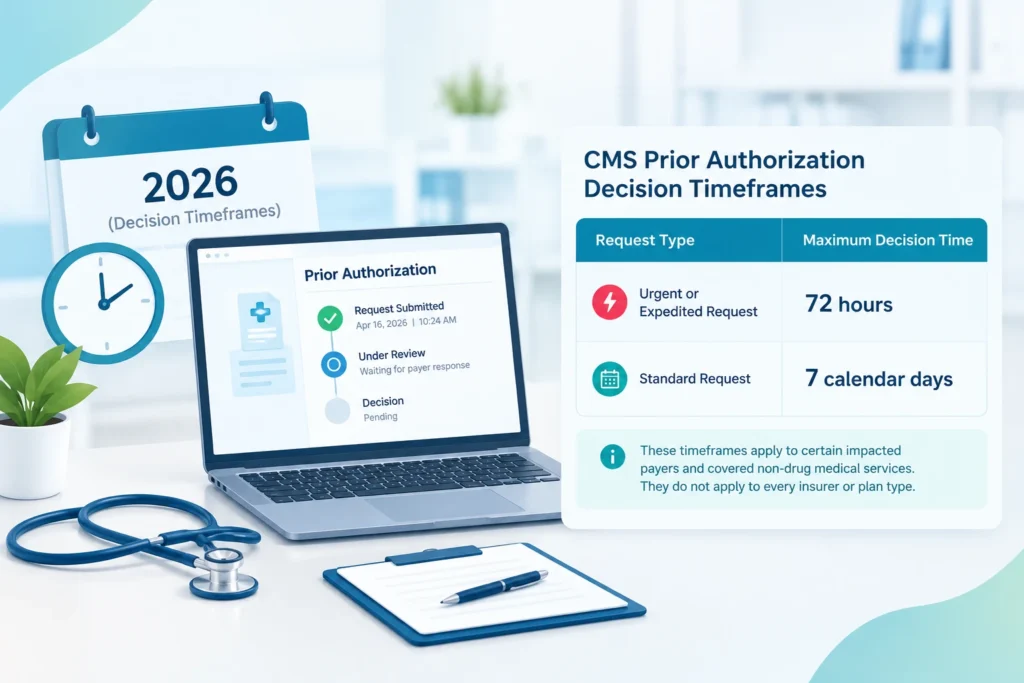
Many key parts of the rule began on January 1, 2026.
For certain health plans, CMS set time limits for decisions on covered medical services that are not drugs.
| Request type | Time limit |
|---|---|
| Urgent request | 72 hours |
| Standard request | 7 calendar days |
These limits apply to the plans covered by the rule. They do not apply to every insurer. The rule also excludes Qualified Health Plan issuers on Federally Facilitated Exchanges from these specific time limits.
The rule also says that covered plans must give a reason when they deny a request.
This helps your team understand the problem. You may need to send more records, fix an error, or appeal the decision.
Read the CMS guide to prior authorization decision timeframes for more details.
What changes are due in 2027?
Many of the rule’s computer system needs are due to start on January 1, 2027. The exact date depends on the type of health plan.
One key part is an API. An API lets two computer systems share data.
Under the rule, certain health plans must offer a Prior Authorization API. It is meant to help users find key details, such as:
- Whether a service needs approval
- Which records the plan needs
- Whether a request was approved or denied
- Whether the plan needs more details
These changes may make it easier for medical teams to check rules and track requests.
Still, each plan and software system may work in a different way. Ask your main health plans and software vendor what they expect to offer.
Read the CMS page on the final rule.
What About Drug Prior Authorization?
CMS has also proposed new rules for drug approval. These rules are separate from the 2024 final rule.
In April 2026, CMS released a proposal called CMS-0062-P. It covers changes to electronic drug approval and related decisions.
As of October 2026, this is a proposed rule, not a final rule. Medical practices should check for updates before treating its dates as firm rules.
Drug approval can depend on how a plan covers the medicine. Some drugs fall under a medical benefit. Others fall under a pharmacy benefit.
The steps may differ. Staff should check the plan’s current rules before sending a request.
Read the CMS fact sheet on the proposed drug prior authorization rule.
How to Improve Your Prior Authorization Process
You do not need to wait until 2027 to improve your process. Your team can start with a few simple steps.
1. Check insurance early
Check the patient’s insurance before the visit or procedure.
Make sure the member details are correct. Check the plan and the dates of coverage. Then find out if the service needs approval.
An insurance check does not replace prior authorization. It helps your team know what to do next.
A clear eligibility verification process can help staff find problems before they delay care.
2. Check the plan’s rules
Each health plan may have its own rules. The rules may also differ by service.
Before you send a request, check the plan’s website or portal. Find out which form to use and which records to send.
Do not assume that an old approval will cover a new service. Check each request before you send it.
3. Send the right records
Missing records can slow down a request.
Check the diagnosis, service details, and doctor’s notes. Add test results and any other records the plan asks for.
Use a short checklist. It can help staff check each request in the same way.
Clear records also make it easier to answer questions from the plan.
4. Track every request
Keep a record of each request. Do not rely on memory or email alone.
Record the date sent, the plan’s reference number, the service date, and the current status. Add a date for the next follow-up.
Give each open request to a team member. This helps make sure someone checks it.
If the plan asks for more details, write down what is missing. Record who will send the records and when.
5. Act on denials
If a plan denies a request, read the reason first.
Check whether the issue is missing records, a coverage problem, or an error in the request. Fix the problem before sending more details.
If you think the decision is wrong, check the plan’s appeal rules. Make sure your team follows the deadline.
A clear denial management process can help your team find repeat problems and reduce extra work.
Common Mistakes to Avoid
Small mistakes can cause long delays. Watch for these common problems:
- Starting too late: A late request leaves little time to fix an issue.
- Using old forms: Check the plan’s latest rules before you send a request.
- Missing records: Send the notes and test results the plan needs.
- Skipping follow-ups: Give each open request an owner and a follow-up date.
- Assuming approval means payment: A claim must still meet the plan’s payment rules.
- Sending the same request again: Read the denial reason and fix the problem first.
A short check before sending a request can save time later. It can also help your team avoid repeat work.
How Prior Authorization Affects Medical Billing
Prior authorization and medical billing are linked. But they are not the same task.
Prior authorization happens before a service when the plan needs to approve it. Medical billing deals with the claim after the service has been given.
If approval is missing or does not match the service, the plan may deny the claim. Staff may then need to check the records, contact the plan, or appeal the decision.
Your team can lower this risk by linking approval checks with scheduling, records, coding, and claim review.
For example, teams that handle orthopedic billing services may need to check approval rules for scans, shots, or planned surgery.
An ambulatory surgery center may also need approval before a case. Learn more about ASC billing services.
The goal is simple. Check the plan’s rules. Get the approval you need. Keep the records. Make sure the claim matches the service.
How to Prepare for 2027
Your team can start preparing now. These five steps can help.
1. Review your current process. Find the services that often need approval. Look at where requests slow down.
2. Talk to your software vendor. Ask what system changes are planned. Find out which new features your current software can support.
3. Contact your main health plans. Ask how they will share approval rules, needed records, and request status.
4. Train your staff. Make sure everyone knows who sends requests and who checks for replies.
5. Track your results. Count pending requests, delays, denials, and repeat follow-up work. Review the results each month.
Do not assume every health plan will make each change on the same day. Check the details with your plans and software vendor.
It is also a good time to review your wider billing process. Learn more about medical billing services and revenue cycle management services.
Conclusion
Electronic prior authorization can help medical practices manage requests and reduce some manual work. The right tools can help, but a clear process matters too.
CMS introduced key changes in 2026. Many computer system requirements are due in 2027. A separate rule for drug approval is still a proposal as of October 2026.
Start with the basics. Check insurance early. Follow the plan’s rules. Send the right records. Track each request.
These steps can help your team manage approvals and avoid some common delays. They can also support a smoother billing process.
Frequently Asked Questions
1. What is electronic prior authorization?
Electronic prior authorization lets a medical practice ask a health plan for approval through an electronic system. It can reduce the need for faxes and phone calls. The practice must still follow the plan’s rules.
2. What is CMS-0057-F?
CMS-0057-F is a CMS rule issued in 2024. It sets rules for certain health plans to improve prior authorization and share data through computer systems. The rules depend on the type of plan.
3. What are the CMS decision time limits?
For certain plans and covered non-drug medical services, the limits are 72 hours for urgent requests and seven calendar days for standard requests. These limits do not apply to every insurer.
4. What changes are due in 2027?
Many computer system needs under CMS-0057-F are due to start in 2027. They are meant to help share details about approval needs, records, and decisions. Exact dates depend on the type of plan.
5. Does the CMS rule apply to every insurer?
No. The rule covers certain health plans. It does not set the same rules for every insurer. Check the plan’s rules before you change your process.
6. Does approval guarantee payment?
No. Approval does not guarantee payment. The claim must still meet the plan’s rules for coverage, coding, records, and payment.
7. Is the 2026 drug rule final?
As of October 2026, CMS-0062-P is a proposed rule. Check official CMS updates before treating its proposed dates as final.
8. How can a practice reduce delays?
Check insurance early, follow the plan’s rules, send the right records, and track open requests. Give staff clear roles for follow-up.
9. What should staff do after a denial?
Read the reason first. Fix missing details or errors, then send the needed records. If required, follow the plan’s appeal steps and deadline.
10. How does prior authorization affect billing?
Missing or incorrect approval can lead to claim denials or late payment. Linking approval checks with scheduling and claim review can help staff find problems early.
Need Help Streamlining Your Medical Billing?
Spend less time managing billing tasks and more time supporting your patients. Explore our medical billing and revenue cycle management services to help your practice improve claim accuracy, manage denials, and reduce payment delays.
Ready to improve your billing workflow? Contact our team to discuss your practice’s needs.