
Healthcare providers work in one of the most demanding industries where accuracy, compliance, and efficiency directly impact patient care. While physicians, psychiatrists, pharmacists, and healthcare teams focus on improving patient outcomes, the financial side of healthcare depends on a complex billing system that requires continuous attention.
Every healthcare organization relies on accurate billing to receive proper reimbursement for the services provided. However, even experienced medical practices can experience revenue loss due to incorrect coding, incomplete documentation, denied claims, delayed submissions, and changing insurance requirements.
Many revenue problems are hidden because they are slow. A missed charge here, an improper modifier there, or an unpaid claim that was never followed up can cause huge financial losses over time.
This is why medical billing audit services have become an integral feature of modern healthcare financial management. These audits help providers identify billing weaknesses, correct mistakes, improve claim accuracy, and build stronger processes to protect future revenue.
A professional audit does not simply search for mistakes. It examines the complete billing workflow to understand where revenue is being lost and how those issues can be prevented.
For healthcare organizations seeking a more organized approach to billing performance, Right Billing Solutions provides support through healthcare billing expertise, revenue cycle improvement strategies, and detailed billing reviews.
What Are Medical Billing Audit Services?
Medical billing audit services are comprehensive reviews of a healthcare provider’s billing records, coding techniques, documentation and payment processes to uncover errors, compliance risks and potential for lost revenue. The purpose of an audit is to compare the services provided with the claims submitted to insurance companies. This process ensures that healthcare providers are receiving appropriate reimbursement while following industry billing requirements.
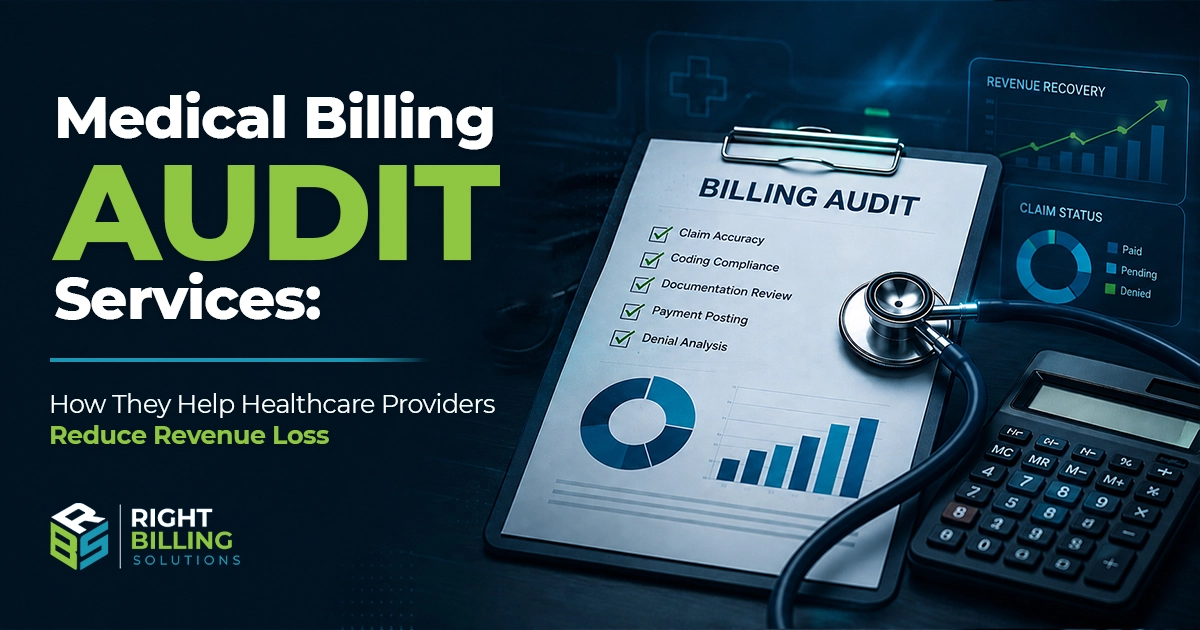
A complete audit reviews different stages of the revenue cycle, including:
- Patient information verification
- Insurance eligibility checks
- Clinical documentation review
- Medical coding accuracy
- Claim submission processes
- Payment posting
- Denial tracking
- Accounts receivable management
An audit provides insight into why revenue difficulties are occurring, going further than a billing check. It allows healthcare businesses to determine whether those issues are due to workflow issues, lack of staff training, documentation issues or payer-related concerns.
Why Healthcare Providers Need Billing Audits
Healthcare billing has gotten more difficult. Insurance restrictions change constantly, coding guidelines are changed regularly, and every specialty has its own specific documentation requirements.
A practice may have skilled physicians and experienced billing staff but still lose revenue because of small operational problems.
For example:
- A physician completes a procedure, but the service is not captured correctly.
- A psychiatrist documents a session, but the selected code does not match the documentation.
- A pharmacy submits a claim with inaccurate information that results in rejection.
- A healthcare organization receives lower reimbursement because of incorrect coding.
These problems may not appear serious individually, but repeated errors can affect the financial health of a practice.
Regular medical billing audit services help providers identify these issues before they become long-term revenue challenges.
Common Problems Identified Through Medical Billing Audits
A successful audit reviews multiple areas where healthcare providers may experience financial leakage.
| Problem Area | Common Issue | Financial Impact |
|---|---|---|
| Medical Coding | Incorrect CPT, ICD-10, or HCPCS codes | Lower payments or claim rejection |
| Documentation | Missing or incomplete patient records | Compliance risks and delayed payments |
| Claim Submission | Incorrect claim information | Increased denial rates |
| Payment Processing | Incorrect payment posting | Revenue tracking problems |
| Follow-Up Process | Unworked denied claims | Lost reimbursement opportunities |
How Billing Errors Cause Revenue Loss
Many healthcare providers assume that major billing mistakes are the primary reason for financial losses. However, revenue loss often comes from small errors repeated over hundreds of claims.
A healthcare practice submitting thousands of claims every month can experience significant losses if billing problems are not regularly reviewed.
Common examples include:
Incorrect Coding
Medical coding determines how healthcare services are represented to insurance companies. Incorrect codes can result in:
- Underpayment
- Claim rejection
- Delayed reimbursement
- Compliance concerns
A medical coding audit helps verify whether the codes submitted accurately represent the services provided.
Missing Charges
Sometimes healthcare providers perform services that are not properly captured in the billing system.
Examples include:
- Procedures not added to claims
- Missed follow-up visits
- Incorrect service documentation
These missed charges directly affect practice revenue.
Claim Denials
Denied claims create additional administrative work and delay payments. Without proper denial management, healthcare organizations may lose money from claims that could have been corrected and resubmitted.
A detailed audit identifies denial patterns and helps practices create better strategies for preventing future issues.
Medical Billing Audit Services for Different Healthcare Providers
Different healthcare specialties face unique billing challenges. A successful audit approach should consider the provider’s specialty, workflow, and patient services.
For Physicians
Doctors often manage complex treatment plans, procedures, and patient documentation. Billing audits help physicians ensure:
- Accurate procedure coding
- Proper documentation
- Complete charge capture
- Reduced insurance disputes
Better billing accuracy allows physicians to focus more on patient care rather than administrative corrections.
For Psychiatrists and Behavioral Health Providers
Mental health billing requires detailed documentation and accurate session coding. Errors in time-based services, treatment documentation, or insurance requirements can affect reimbursement.
A billing audit helps psychiatrists identify:
- Documentation inconsistencies
- Coding errors
- Missing billing opportunities
- Claim rejection patterns
For Pharmacists and Healthcare Facilities
Pharmacies and healthcare institutions have to deal with complex reimbursement systems with insurance carriers and healthcare programs.
Audits help review:
- Claim accuracy
- Payment discrepancies
- Insurance processing issues
- Reimbursement delays
Medical Billing Audit vs Regular Billing Review
Many offices perform routine audits of their bills, but a professional audit gives a more in-depth examination.
| Feature | Regular Billing Review | Professional Audit |
|---|---|---|
| Main Purpose | Check daily billing activity | Identify revenue risks and improvements |
| Review Level | Basic | Detailed analysis |
| Coding Evaluation | Limited | Complete coding assessment |
| Compliance Review | Minimal | In-depth compliance evaluation |
| Recommendations | General feedback | Action-based improvement plan |
A regular review helps maintain daily operations, while an audit helps improve the entire revenue cycle.
How Audits Improve Healthcare Revenue Cycle Management
Healthcare revenue cycle management involves every financial step from patient registration to final payment collection.
A weak revenue cycle can create:
- Increasing accounts receivable
- More denied claims
- Delayed payments
- Administrative workload
A detailed audit strengthens revenue cycle performance by identifying areas that need improvement.
| Revenue Cycle Stage | Audit Focus |
|---|---|
| Patient Registration | Verify accurate patient information |
| Insurance Verification | Confirm coverage details |
| Documentation | Ensure records support services |
| Coding | Improve accuracy and compliance |
| Claims Processing | Reduce rejection rates |
| Payment Collection | Improve reimbursement tracking |
By improving each stage, healthcare providers can create a more stable financial system.
The Medical Billing Audit Process: Step-by-Step Explanation
A successful audit follows a structured process that examines every important part of the billing cycle. The goal is not only to identify errors but also to understand why those errors occur and how healthcare providers can prevent them in the future.
Professional medical billing audit services usually involve several stages, starting with collecting billing information and ending with recommendations for improving revenue performance.
1. Reviewing Billing Documentation
The first step is reviewing patient records, claim details, and supporting documentation.
Auditors compare medical records with submitted claims to confirm that:
- Services billed match services provided
- Documentation supports the billed procedures
- Codes accurately represent patient care
- Required information is complete
It is important to document accurately since insurance companies look at the patient’s medical record to decide if a claim meets their requirements for reimbursement.
2. Analyzing Medical Coding Accuracy
Medical coding is a critical part of healthcare reimbursement. A small coding error can be the difference between a claim being paid, reduced, or denied.
During a coding review, auditors evaluate:
- CPT code accuracy
- ICD-10 diagnosis selection
- Modifier usage
- Procedure documentation
- Specialty-specific coding requirements
A thorough medical coding audit assists healthcare providers in keeping up with appropriate billing practices while lessening needless payment delays.
3. Reviewing Claim Submission Processes
Auditors will check documentation and coding, then consider how claims are submitted.
This includes checking:
- Claim accuracy
- Submission timelines
- Insurance requirements
- Rejection reasons
- Missing information
Many of the difficulties come down to workflow concerns rather than deliberate errors. Identifying these weaknesses helps healthcare organizations develop better billing practices.
4. Evaluating Denied Claims
Denials of claims are among the largest revenue issues for healthcare providers.
A proper audit examines denied claims to determine:
- Why claims were rejected
- Which errors occur most frequently
- Whether corrections were properly handled
- How future denials can be reduced
This approach improves claim denial management by addressing the actual causes behind rejected payments.
5. Creating an Improvement Strategy
After completing the review, auditors provide findings and recommendations.
A typical audit report may include:
| Audit Finding | Recommended Action | Expected Improvement |
|---|---|---|
| Frequent coding errors | Improve coding review process | Higher claim accuracy |
| Delayed claim submissions | Strengthen workflow monitoring | Faster reimbursement |
| High denial rate | Analyze denial patterns | Reduced payment delays |
| Missing documentation | Improve record management | Better compliance |
The purpose of an audit is not simply to highlight problems. It provides healthcare providers with practical solutions for improving financial performance.
Key Benefits of Medical Billing Audit Services
Healthcare organizations invest in audits because accurate billing directly affects their financial stability.
The following benefits make professional audits valuable for medical practices of all sizes.
1. Reduces Revenue Leakage
Revenue leakage is when healthcare providers don’t get money they are supposed to receive.
Common causes include:
- Incorrect billing codes
- Missed charges
- Underpayments
- Unresolved claims
A thorough audit helps discover where revenue is being wasted and gives strategies to reclaim those opportunities.
2. Improves Billing Accuracy
Accurate billing builds better relationships between healthcare professionals, insurance companies and patients.
When claims contain correct information:
- Approval rates improve
- Payment delays decrease
- Administrative workload reduces
Improved accuracy also helps healthcare teams maintain better financial records.
3. Strengthens Medical Billing Compliance
Healthcare organizations must follow strict billing and documentation standards.
Compliance-focused audits help providers:
- Identify potential risks
- Maintain accurate records
- Follow proper coding guidelines
- Reduce billing-related issues
For physicians and healthcare administrators, compliance is essential for long-term operational stability.
Many practices have unpaid or underpaid claims that could potentially be recovered.
4. Helps Recover Lost Revenue
Audits help identify:
- Incorrect insurance payments
- Unfollowed claims
- Missed reimbursement opportunities
Recovering existing revenue is often more cost-effective than increasing patient volume.
5. Saves Administrative Time
Healthcare providers already have their hands full. Too much time spent on billing difficulties might negatively impact productivity.
Providing professional auditing help allows medical teams to focus on:
- Patient care
- Clinical responsibilities
- Practice growth
while experts analyze billing performance.
Common Medical Billing Mistakes Healthcare Providers Should Avoid
Even experienced healthcare organizations can face billing challenges. Understanding common mistakes helps prevent unnecessary revenue loss.
1. Incorrect Patient Information
Small registration errors can cause claim delays or denials.
Examples include:
- Incorrect insurance details
- Missing patient information
- Wrong demographic data
Accurate patient information should always be verified before claim submission.
2. Incomplete Documentation
Documentation supports every healthcare claim.
Missing information can create problems such as:
- Claim rejection
- Compliance concerns
- Payment delays
Healthcare providers should ensure that medical records clearly support the services billed.
3. Poor Follow-Up on Denied Claims
A denied claim does not always mean lost revenue.
Many denied claims can be corrected if they are reviewed quickly and submitted properly.
Without an organized follow-up process, healthcare organizations may lose money from claims that could have been recovered.
4. Lack of Regular Billing Reviews
Waiting until financial problems appear can make revenue issues harder to fix.
Regular audits help identify problems early and maintain a healthier revenue cycle.
How Technology Supports Modern Medical Billing Audits
Technology has changed the way healthcare organizations manage billing processes.
Modern billing systems can help identify patterns, track claims, and improve reporting accuracy.
Technology-supported audits can review:
- Claim performance trends
- Payment history
- Denial patterns
- Coding accuracy
- Revenue cycle reports
But technology cannot substitute for professional expertise. Understanding documentation, coding regulations and specialty-specific criteria for healthcare billing still requires human analysis.
Choosing the Right Medical Billing Audit Partner
Selecting an experienced audit partner is an important decision for healthcare providers.
The right company should understand healthcare regulations, coding practices, and revenue cycle challenges.
Important Factors to Consider
| Factor | Why It Matters |
|---|---|
| Healthcare Experience | Ensures understanding of medical billing challenges |
| Coding Knowledge | Improves claim accuracy |
| Compliance Understanding | Reduces billing risks |
| Reporting Quality | Provides clear improvement recommendations |
| Industry Knowledge | Supports specialty-specific requirements |
A reliable partner should focus on long-term improvement rather than only identifying short-term errors.
Why Healthcare Providers Choose Right Billing Solutions
Healthcare providers need billing partners who understand that every claim represents valuable time, resources, and patient care.
Right Billing Solutions focuses on helping healthcare organizations improve billing accuracy, manage revenue cycle challenges, and identify opportunities for better financial performance.
Effective billing support should not be a one-size-fits-all solution, but one that is tailored to each practice’s expertise, workflow and operational goals.
Whether a provider is looking for help with billing reviews, coding accuracy, claim analysis or revenue cycle improvement, skilled personnel can lead to improved financial results.
Final Checklist Before Selecting Billing Audit Services
Before hiring an audit provider, healthcare institutions should consider:
- Does the company understand healthcare billing regulations?
- Can they analyze coding and documentation accuracy?
- Do they provide clear audit reports?
- Can they identify revenue improvement opportunities?
- Do they understand specialty-specific billing challenges?
- Do they focus on compliance and long-term growth?
Choosing the right partner can help healthcare providers maintain accurate billing systems and protect their revenue.
Conclusion
Healthcare providers work hard to deliver quality patient care, but financial challenges caused by billing errors can affect the growth and stability of a medical organization. Incorrect coding, denied claims, incomplete documentation, and missed reimbursement opportunities can quietly reduce revenue over time.
Professional medical billing auditing services allow healthcare providers to catch these issues before they become large financial difficulties. Audits can provide a picture of what needs to be improved by looking at billing processes, coding accuracy, documentation practices and claim performance.
Regular billing assessments provide doctors, pharmacists, psychiatrists and healthcare managers with tighter financial management, while promoting compliance and operational efficiency. A competently managed billing system helps physicians focus more on patient care and less on time spent fixing needless billing problems.
Choosing the proper audit partner can help healthcare firms improve reimbursement accuracy, avoid claim denials, and establish a more robust revenue cycle management process. Healthcare providers can create a proactive approach to defend their bottom line by partnering with skilled consultants like Right Billing Solutions.
A billing audit isn’t only about catching mistakes. It’s about building a better system that supports sustainable development, accurate reimbursement and improved healthcare operations.
FAQs
1. What are medical billing audit services?
Medical billing audit services offer expert reviews of billing data, accuracy of coding, claims and payment processes. They assist healthcare providers in recognizing faults and enhancing revenue performance.
2. Why do healthcare providers need billing audits?
Billing audits can help doctors and healthcare organizations find revenue leaks from coding mistakes, denied claims and documentation problems. They also enhance billing accuracy and compliance.
3. How often should a medical practice conduct a billing audit?
Most healthcare practices should be conducting frequent audits at least annually. Larger enterprises may need to check more often to ensure the correctness of information and avoid loss of revenue.
4. Can billing audits help reduce claim denials?
Yes, audits will reveal frequent reasons for denial, such as code flaws, missing documentation or claims with wrong information. Solving these difficulties helps to improve claim approval rates.
5. Who can benefit from medical billing audits?
Physicians, psychiatrists, pharmacists, specialist clinics and healthcare organizations can benefit from billing audits. They help to get better reimbursement and optimize financial operations.
6. What does a medical billing audit review?
A billing audit is an examination of medical codes, patient records, insurance claims, payment logs, and billing procedures. The purpose is to ensure proper billing and correct reimbursement.
7. How do billing audits improve revenue cycle management?
Billing audits reveal points of weakness in the revenue cycle, such as delayed claims and payment delays. They help providers develop better systems to get paid faster and more accurately.
8. Can a billing audit identify compliance problems?
Yes, audits can reveal documentation deficiencies, coding errors and billing procedures that may pose compliance issues. Early identification allows suppliers to maintain correct billing standards.
9. What is the difference between a coding audit and a billing audit?
A coding audit is primarily concerned with medical codes and documentation accuracy. A billing audit evaluates the entire billing process, including claims, payments, denials and revenue performance.
10. How do I choose the right medical billing audit company?
Select a company with healthcare billing exposure, coding knowledge and a good understanding of regulatory needs. The proper partner will give you concrete findings and tangible ideas for development.